There are
a lot of reasons why the A-Series engine is a nightmare to
run on fuel injection – all of them linked to the five
port head. With cylinders 1 and 2 sharing one inlet port and
3 and 4 sharing the other inlet port you get a problem related
to the firing order. Basically one port draws in the fuel/air
mixture followed immediately by the other paired cylinder.
This charge robbing is not such a problem with the engine
fed from an SU carb’. The air/fuel mixture is mostly
prepared before it enters the port and each cylinder draws
from this. Due to the cylinders 1 & 2 and 3 & 4 being
paired along with a conventional firing order of 1-3-4-2 there
is an uneven period between the intake strokes of the paired
cylinders. In fact cylinder 2 will start drawing in air before
cylinder 1 has finished its intake stroke (this is where the
charge robbing effect comes into play).
Whilst the charge robbing does have an affect fuel distribution
with SU carbs it creates much more of a headache for fuel
injection.
Twin
port injection
Even with
a fully sequential system it is normal for the the injector
opening time to overlap the inlet valve opening time at higher
rpm and load’s. This is going to cause a problem with
the A-series engine because the some of the fuel destined
for one cylinder will end up in the next cylinder. The end
result on a fuel injected A-series is two cylinders than run
lean (cylinders 1 and 4) and two that run rich (cylinders
2 and 3). Clever injector pulse timing and relatively large
fuel injectors will allow you to get a measured quantity of
fuel into each cylinder (as shown with Rover’s own fuel
injected A-series system). The next problem is that as the
engine is tuned and bigger cams are used the injection window
actually becomes smaller and the injector size has to increase
– so much so that high powered aspirated engine with
twin-port injection it not really practical.
Single
port injection
A single
port injection set up is much like an electronic SU, sometimes
referred to as running a wet manifold. Here the SU is replaced
with a single butterfly throttle body. The fuel is injected
just after the butterfly so that the mixture can be prepared
before being drawn into the ports. This solution is a compromise
- it allows you to control the fuelling more precisely than
an SU without the complication and limitation of a sequential
twin-port arrangement. As with the SU carb the distribution
may not be perfect.
So there are three possible answers to fuelling the A-Series
engine.. Answer number one will be discounted here –
that’s fit an SU carb! Answer number two is to have
a sequential injection system which keeps the injector trigger
points apart from each other. This is the Rover system outlined
above. The problem with this system is that the time frame
available for injection is very short on the robbed cylinder,
making it really unsuitable for bigger power engines. If you
are making a lot of power then you need very big flowing injectors
to fit all the fuel in within the limited available time frame.
The easiest option is to run the inlet manifold as a “wet”
system as with the carb. The injectors trigger way back up
the inlet manifold and the engine doesn't know that you do
not have a big SU carb bolted to the manifold. The difference
from the SU set up is that you have full control of the fuelling
at any given rpm and load site. On the 1275cc engine shown
in this project we started out with a rebuilt engine on a
soft MG cam - making 75 bhp on the original twin 1.25 inch
SU carbs. The mapped ignition we had previously fitted made
the car very flexible and the fuel consumption improved considerably
compared to the advance weight control in the distributor.
One of the first problems with fitting injection to a carburetor
car is the fuel supply system. An injection system has no
float chamber to act as a fuel reservoir during cornering.
If you get fuel surge in a corner the engine cuts, or starts
to cough, straight away. Rather than remove the fuel tank
and baffle the pick-up, it is easier to fit a swirl tank under
the bonnet. This is fed from the normal carb pump and the
injection just circulates from the swirl tank to the fuel
rail and back again.
By having a small tank under the bonnet you regain your fuel
reservoir and keep the high pressure fuel pipe runs to a minimum.
The tank in the pictures was welded up from stainless steel
and mounted on rubber doughnuts. The fuel lines are clipped
and crimped in place with turned up adapters where necessary.
Engine
mods
We decided
to go the whole hog on this engine and fit a crank trigger
for dizzy-less operation. Rather than make up a wheel we machined
the front damper with slots on the milling
machine. Before you do this you MUST make up your sensor
bracket and position the sensor. Then you cut the slots so
that gap lines up with the sensor when the engine is approx.
90 degrees BTDC (for a 36-1
pattern wheel). This 90 degree position is adjustable
in the ECU’s software but it makes life easier to be
somewhere near the default settings to start with. The reference
is the woodruff key in the pulley, it sits dead vertical at
TDC. The LCB exhaust was drilled and two bosses fitted so
we could install a lambda sensor in an outer cylinder as well
as the center pair of cylinders.
Monitoring
the two sensors would show us how the injection distribution
was being affected by the charge robbing. The distributor
was retained with a single toothed Lumenition optical trigger
that could now work as a cam phase sensor should we wish to
look at running the engine sequentially in the future.
After checking the plumbing for leaks the car was fired up
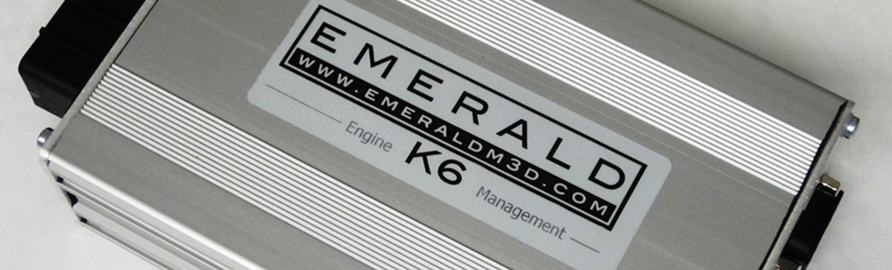
for the first time on the new injection system. The ECU was
the normal M3Dk unit, but with each injector on a separate
injector channel that fire out of phase from one another.
The result is injections events that occur twice as often
and alternating between the two injectors. Cold start is monitored
against engine water temperature and for this we had drilled
a second hole in the head under the thermostat housing. You
need to be reading engine temperature straight into the ECU,
not radiator temperature.
Mapping
On the
rolling road we were concerned that the injectors we had used
might not be large enough in terms of peak flow rate. According
to the calculator we had enough fuel for just under 90 bhp
but that was extending the duration to almost 100 per cent.
Ideally you need to keep the maximum injector duration to
80 per cent. There was no sign of charge robbing at all and
the engine mapping worked out fine. We had lifted peak power
from 75 bhp to 90bhp. That’s a power gain of just over
20 per cent against the twin SU carbs.
Problem
On the
road we now came up against a bit of a problem. The stock
suspension was being stretched to cope with the new increase
in torque and we need to do something about it. There was
also an oil leak from the engine, in spite of having taken
the engine out to cure the leaks!
The owner of the car reports much improved fuel consumption
and a noticeable improvement in drive-ability as well as outright
performance. |